The Dimmer Switch
Blake Rayne
first published in Émergent magazine, London, issue 14, October 2025, titled "Paperwork as Brush"
(01) Merlin Carpenter’s work stays in the room after you’ve left, not because it resolves neatly into a quotable thesis or a signature image, but because it refuses to let the conditions of its own presentation fall back into invisibility. That refusal matters in a culture that asks art to be instantly legible, theme-forward, and frictionless, the streamlined deliverable the circuit currently rewards. I’m writing from inside that pressure, trying to keep a line alive that Carpenter thickens rather than invents: a line where context is not a backdrop but material; where form is not only composition on a surface but the procedures, scripts, and beliefs that make a work possible; where painting isn’t a protected enclave but a site for staging those procedures in public. If there’s a bias here, it’s toward keeping going, against the impulse to throw the baby out with the bathwater in the name of permanent present-ness.
(02) I’m not going to list iconography in Merlin Carpenter’s practice, The Counter-fits, Burberrys, models, stars, „Heroes“, “Circuits”, steam, nor my own associations with them. I’m not going to reroute through histories that flatten the work into cynicism or nihilism for a quick traversal. I’m not offering a fix for the problems the practice renders.
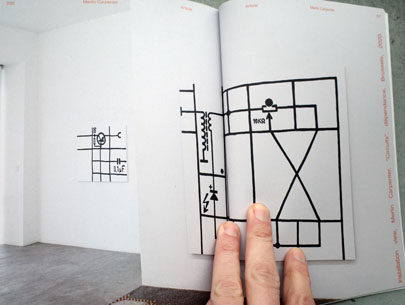
(03) Call it a tempo problem, mine as much as the culture’s. The passage is quick, institutions, galleries, DIY, and that speed is treated as material, not mood. What I’m tracking is an imperative Carpenter keeps in view: expose the apparatus; cut the fog of bourgeois idealism; let a materialist staging of work come into view. I follow Thom Andersen, his writing, his teaching, his work. By “staging of work” I mean the post-centre procedural kit, montage, timing, framing, logistics, credits, worked in space, after cinema’s centre has splintered. A materialist practice treats what’s already distributed as given; protocols, efficiency programmes, success models, smooth categories (whether morphological or thematic), as material, not backdrop.
(04) Start with the boring clarification: Carpenter has always labelled himself as an artist “and” painter. Read “painter/object” as naming the protocols of painting as a culturally efficient distribution format, portable, legible, registrable, insurable, easily routed through crates, customs, fairs, and press. He keeps that channel open precisely to insist (performatively) on a materialist programme: treat the channel itself as material, not backdrop. The “and” matters: it buys mobility across protocols (“painter” unlocks the single-object success model; “artist” legitimates museum-scale staging of work; registrar, press, education, shipping, as form). It blocks style capture. Without the “and,” “painter” pins him to morphology and signature; with it, procedures stay in view.
(05) It clarifies labour (“painter” = one job classification; “artist” = multi-position producer, directing, commissioning, timing a tour). It steadies credit politics (delegation doesn’t break authorship; “painter” keeps the field of painting expanded to supports, timing, invoices). It lets him modulate temperature (“painter” cools expectations; “artist” permits administrative and performative heat). It threads lineage without collapse (Robert Ryman’s object-edge to Daniel Buren and Michael Ashers’ institutional staging; a pop key of display and circulation) and addresses different audiences while keeping routing incomplete so the work can re-route them.
(06) What gets called a painting is constellated with the protocols of its appearance: press email or none; wall colour and hang height; courier and bill of lading; customs hold and crate; lighting cue; late arrival by air; the rattle of a trailer. What’s sacrificed is easy recognisability, the name-card logic of practice. Repetitions and consistencies still abound, Burberrys, the circuits, but “circuit” appears as an image that marks traversal across staging scenarios: a repurposed shop gallery, a small Paris apartment project space during lockdown; a construction trailer. Context is material; call that the staging of work at object and institutional scale.

(07) The point is method, not pedigree or illustration; that doesn’t mean appearances don’t matter, of course they do. So while Carpenter keeps limits and supports legible and scales that analytic to the institution so procedures, scripts, and logistics stay in frame, the surface retains its pop because pop is the key that lets the system play on the surface. Warhol’s ghost stays near, extremely serious about keeping it light, seriality and display as circulation, not flourish.
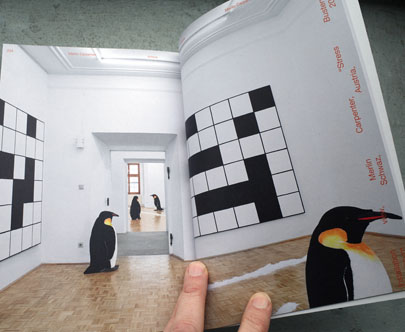
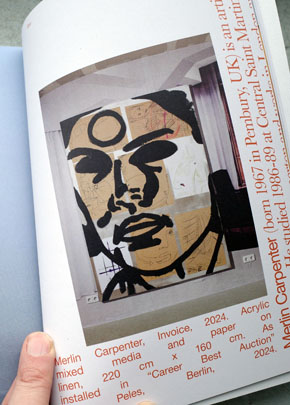
(08) Call it paperwork as brush: show the specs so the “painting” includes its supports. Operational cool keeps the temperature where procedure reads and image-effects don’t pose as refusal. “Stress Busters” (2024). The attention shifts from depth to surface operations, demonstration, here and now. Even when the graphic is delayed, wandering drawing, a layout spread, the paper-on-canvas mount keeps support and routing in frame, finally, as in “Career Best Auction” (2024), a painter on the cover of the face.
(09) Form isn’t only picture-making; it includes career, the show, the press cycle, the feed. If spectacle names images ruling social relations, immediacy names the smoothing protocol that erases mediation and history in favour of an endless now. Spectacle rides immediacy like a skin, a liniment of obfuscation that veils a global production crisis. In that climate, format is how spectacle appears: the show as movie, the feed as series.
(10) Following T.J. Clark’s reading of Tony Oursler’s The Influence Machine,* where “steam” names a medium turned atmosphere and a re-timing of looking, the present analogue is the interface. Captions, thumbnails, checklists, floor plans, and press cadence pre-format recognition and accelerate assent. Merlin works there. He externalises the supports, list, bio, venue, price, logistics, so that admin becomes medium: paperwork as brush. The result is not a picture of spectacle but an operation that slows immediacy and keeps belief under test; “career” is taken as form, and the frame’s instructions are made audible.
(11) Cinema remains (perhaps) the aspiration for all the arts, although it no longer occupies the centre. The centre has splintered; its belief-wall, like the Berlin Wall post-demolition, has gone elsewhere. What endures is the ghost of cinema as model: selection, framing, editing, duration, logistics, credits, the kit that persists as procedure, as Thom Andersen frames it in Slow Writing (The Visible Press, 2017). In “Steam Engine” (2021), the room is dense with steam; the press release as epi-steam; cinematic mode as equipment, not metaphor; an instrumented “ineffable.” Here infrastructure is theater.

(12) The “ineffable” here is the alibi at representation’s limit, what Buren names in his text on Ryman (L’Ineffable, 1999) to mark the edge where presentation takes over. In Merlin Carpenter’s hands it’s engineered atmosphere, epi-steam, lag, handoffs, an instrument, not a mystery; call that “ineffable” what it is: the operating tolerance of the kit.
(13) “Form” includes scripts too often naturalised, treated as self-evident. Career is one of them.
(14) Carpenter treats career as form and composes with it: shows read like chapters, runs like a season, the tour as structure rather than romance. Each exhibition is a new staging; sometimes a strike on the job, sometimes a roadshow, sometimes a deskilled star turn, sometimes a restaging of processes of formation, that reworks the relation between form, format, and career. Efficiency is the house style of format: success models pre-sort work for travel, single painting as proof, or an installation as proof, so object or show can pass cleanly through routes without cross-contaminating lanes. Why are we still yearning for the real thing?
(15) Carpenter scales the unit to the whole museum, galleries, gift shop, education wing, shipping and receiving, curatorial, press, so the apparatus reads as material. If there’s cinema here, it’s post-centre, infrastructural: trailers, registrars, press cycles, feeds, dashboards as the credit roll. Here, infrastructure as theatre.
(16) Sometimes the tour is literal, trailers, logistics, fog, so the show’s cinematic mode operates as equipment, not metaphor. A trailer is three things at once: a mobile container, a movie trailer, and a logistics drawing. Seasons arc, then stutter; cuts land before the platform’s tidy resolution so the procedure remains legible as form.
(17) Painting is a job inside a system. If the format requires a star, one is in stock; exposure is the requirement. The images that appear in painting, „Heroes“, Scarface, Rosa Luxemburg, attractors, carry their thumbs-up and thumbs-down already attached; they move like copies with the same pass: cover-ready, thumbnail-legible, clearing checkpoints without asking for deep compositional authority. Stars are supplied as stock, extras, raw, so charisma drains and the requirement shows; even the rating glyphs, stars, thumbs, are stock. A flat black oil silhouette from Scarface pasted on a monochrome ground plays “star” and hole at once. Speed enough to clear the checkpoints, one blink, and what’s left are charges in the names and seams in the handling. The move is use. This isn’t to say there aren’t feelings or associations; it’s to emphasise operation: fix the ready-made to its route until the procedure, not the pose, shows; what remains is the belief that clings to it.

(18) Beliefs cling to images like static. They promise freedom, genius, self-determination; in use they buckle. Bring them to form and the welds show. Scripts arrive ready-made, mandates, best practices, theme decks, and painters run them until the seam is visible. None of this fixes a problem.
(19) It keeps the problem public, workable, not a given. Usage isn’t agreement; it’s how a claim is routed until its failure can be handled as material. Inside the regime, not outside it: protocols of attention and circulation are handled as material, not affirmed as myths. Platforms are supports, not masters; the website routes rather than gathers, and its failure is useful. Visibility stays a degree; some shadow is preserved.
(20) The stream wants speed; attention shrinks to a blink. In Carpenter’s hands the counter isn’t heat but angle and pacing: underacting, deskilled stars, administrative time, fog, flats, shipping tags, late arrivals. The format is staged raw, then nicked. The temperature stays where procedure reads and the image doesn’t pretend to be the refusal. Cuts and lags survive the scroll; what registers is the join. A breathless economy of cuts and joins.
(21) To exhaust the material, the tactic is inside: working-to-rule, a strike on the job, reading the line print of the contract very carefully; each protocol followed aloud until the protocol is the picture. At museum-scale, registrar, courier, insurance, education, shop, press, and lighting read as the image. The stoppage happens at performance, not in a manifesto. “Demonstration” is both public act and example: scripts are called by name, exhibition logic, career logic, success model, and run until the gears squeal. From there “painting” names the field: pigment and canvas, yes, and also hang, light, invoice, crate, customs.
(22) That logic appears in other practices, too. K8 Hardy registered a performance, Trade (2025), as a demonstration along Checkpoint Charlie and then just drove, back and forth with companions, until a line opened. In a June rain, people stepped off the pavement and followed into the street, joining a dumb, stubborn gesture that pierced a belief-wall by occupying space together. Not anonymous, not a star turn; just enough visibility to move together. Not a slogan; a route: repetition made the border visible, then crossable, for a minute.
(23) Carpenter’s recent show in Tokyo, “Vintage” (2025), the face motif persists, out of “Career Best Auction” (2024), re-staged in Tokyo (Vintage). Black exterior paint carried a face graphic across the interior walls and upstairs rooms; drips, seams, and an “MC ’25” mark keep the handling visible.
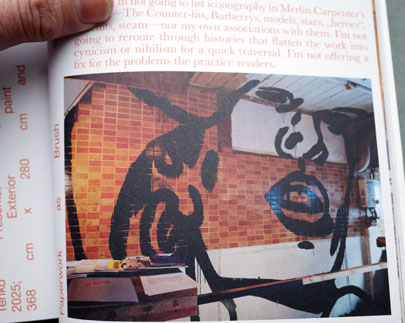
(24) The takeaways were pencil drawings of Trier (birthplace of Karl Marx, as noted in the press release, and made in 2006 in Beijing), presented in home-made clip-frame
analogues: thick plexi front, thick grey card back, held with metal clips; display-only for floor or rack. A few sat inside, and a small stand outside offered them like souvenirs. It set up a draw between two, plein air sketch and street-art mural, each losing its “outside” once routed through private property. The storefront window, that old-fashioned despot, and the screen make the tie obvious: inside, the mural behaves like property; outside, the drawings pose as street; online, the same sheets reappear out of their plexi, taped to a wall on merlincarpenter.com.
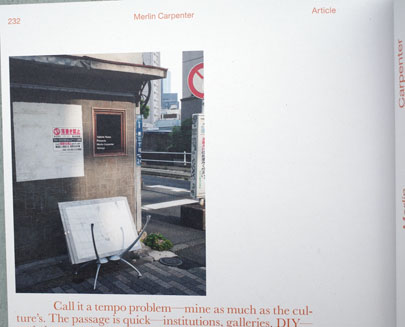
(25) One image routes wall → stand → screen. “Vintage” stickers stray into the alley and back, another route folded in. Fixed to a wall, kept mobile by routing; the fix reads as stage, not monument, avoiding the statism that haunts permanent décor after Buren settled into the Palais Royal. Not a moral; distribution made legible, supports named, transgression cooled, handling still visible. And the hand’s job, old-fashioned, still drawing attention, on the picture plane, not plein air; online; but in plain view; no trip east required.
(26) The method stays blunt. The given is not treated as nature, no second nature. Context is material. Perform → inform → transform remains a relay, paused before it hardens into a look. Risks remain, brand capture, star/hole as motif, but a cool hand keeps the joins readable. Visibility stays on a dimmer, not a switch; time and site do the work. Not a programme so much as movement: reading scripts, finding seams, intensifying possibilities in the fissures. Carpenter’s work isn’t a metaphor for something else; it is paint, support, hang, light, invoice, crate, courier, glitch, made to work in public. It stays in the room after you leave. If the frame is between us, what belongs in that space now: walls, or paths?
* T.J. Clark, Modernism, Postmodernism, and Steam, October 100 (Spring 2002): 154–174.
thanks to Émergent magazine
texts, bibliography, info, home